
Variant A
Every post
leaves
checked.
Autopostmate is a small production line for social posts. It writes from your own records, checks its work twice, and stops for you before anything is drawn or sent.
Every new account starts on Solo for seven days, no card, then Free. Plans and prices.
Research
ModelThe writer only knows what you have put on file. Here is everything it was handed for this brief. Nothing else.
Brand voice
Proof points
Never say
On the shelf
Key date
Generate
ModelExactly two variants. Never one, never five. Two is enough to choose between and few enough to read.
Variant B
Copy guardrails
CodeNot a model. A set of validators that read every variant the same way every time: your never-say list, the platform's character limit, patterns that look like personal data. A miss goes back to the writer before anything is rendered.
Variant B
Sent back. The writer gets the finding, not a hint, and rewrites. Variant A passed and does not move.
Variant B, rewritten
Fact-check
ModelA second reader with web search, told to be difficult. It takes each claim in turn and reads it against your proof points. What it finds is attached to the variant. It never blocks. That is your job.
Copy selection
YouThe line stops here and waits. Pick the variant that sounds like you. Nothing is drawn until you do.
In the product you can also edit the caption here. Every keystroke is re-checked by the same guardrails, for free.
Design
ModelThe model chooses a layout for the variant you picked. Only that one. The pixels are drawn by plain code from your colours, your logo and a template, so the same choice always renders the same slide.
- Layout
- Background
- from brand palette
- Text
- from brand palette
- Logo
- Bottom right preset
- Copy
- Variant , as chosen
Visual checks
CodeCode again. Can the text be read on the band? Is the logo clear of it? The numbers below are being computed by this page, right now, from the slide above.
- Text contrast on the band
- Logo clear of the text band bottom right, 4% inset pass
- Headline within cap pass
The band failed at . The renderer darkened it and measured again. That corrective pass is a rule, not a judgement call, and it runs before you ever see the slide.
Final approval
YouThe line stops again. Approve it, send it back with a reason, or move the text and logo yourself. Moving a layer is a re-render, never a model call, and never spends a generation.
awaiting_final_review · attempt 1 of 3
Available on the real one.
Rules the line keeps
None of these is a setting. They are how the pipeline is built, and they hold whether or not you are watching.
- It stops for you twice.
- Once before anything is drawn. Once before anything leaves.
- Checks are code wherever they can be.
- Guardrails are validators, not prompts. The same input gets the same verdict.
- Fact-check advises. You decide.
- A verdict is a warning beside the copy. It never disables a button.
- Only the chosen variant is drawn.
- Two captions, one deck. The other one is never rendered.
- Three sends-back per brief, then it asks.
- After the third rejection the line stops and offers two paths: take the best so far, or fix the layers by hand.
- Edits never spend a generation.
- Caption edits, layer moves, look changes and copy checks are free. The monthly allowance counts runs.
The rest of the floor
The line is the point. Around it sits what a small shop needs to keep it fed.
- Knowledge base
- Six kinds of record, each a form you fill once: identity, voice, products, proof points, key dates, assets.
- Looks
- Slide templates by vibe. Pick one on the brief or swap it at final approval.
- Planner
- A chat that proposes posts and campaigns for a month. Nothing lands on the calendar without your Apply.
- Calendar
- Plan by month, drag a post to another day. No model in it.
- News feed
- Headlines from sources you follow. One click turns an article into a grounded brief.
- Publish
- Export the caption and slides as a ZIP, or post to LinkedIn once connected.
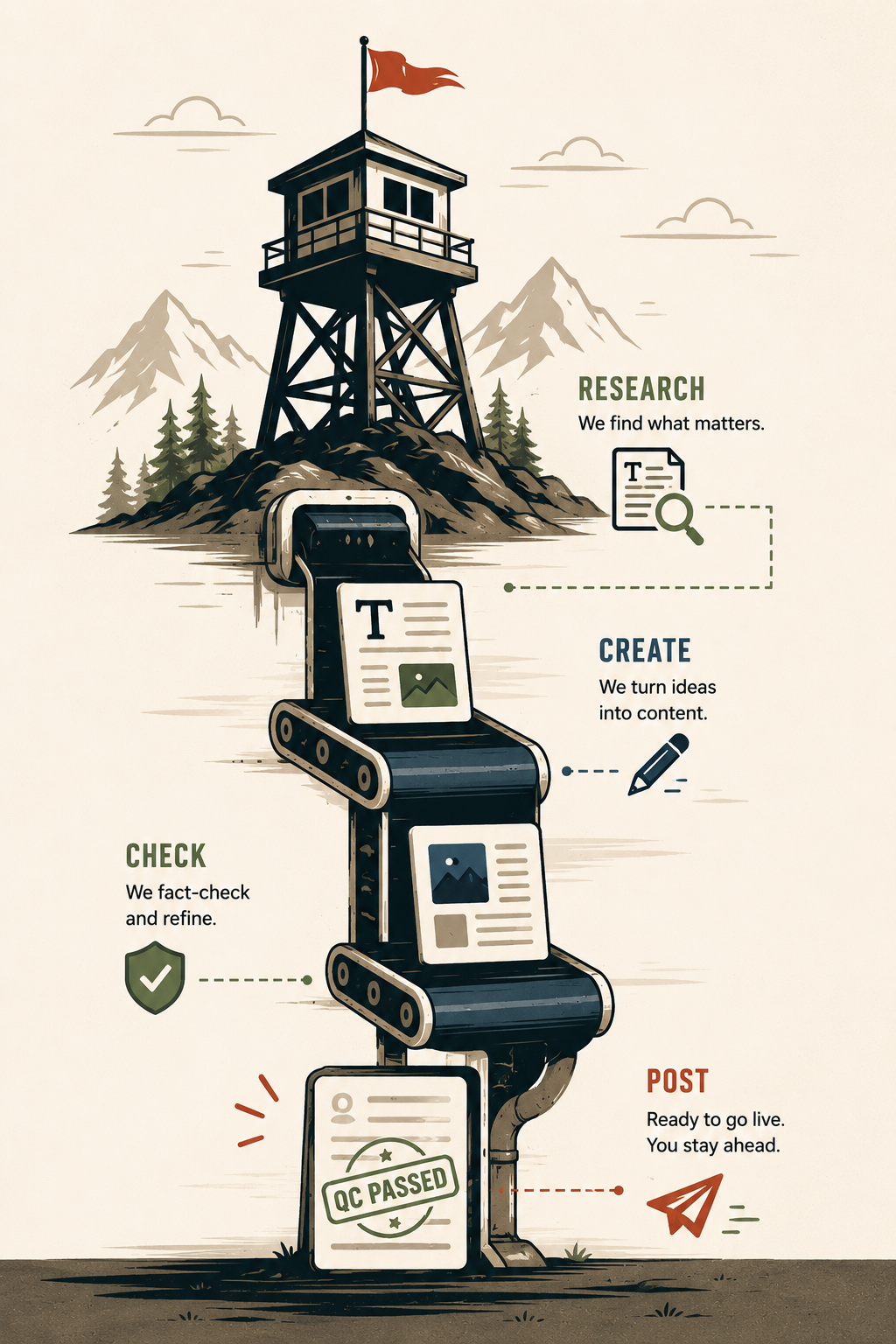
Put your own shop on the line.
Set up the knowledge base once. Every post after that is written from it, checked against it, and waits for you.